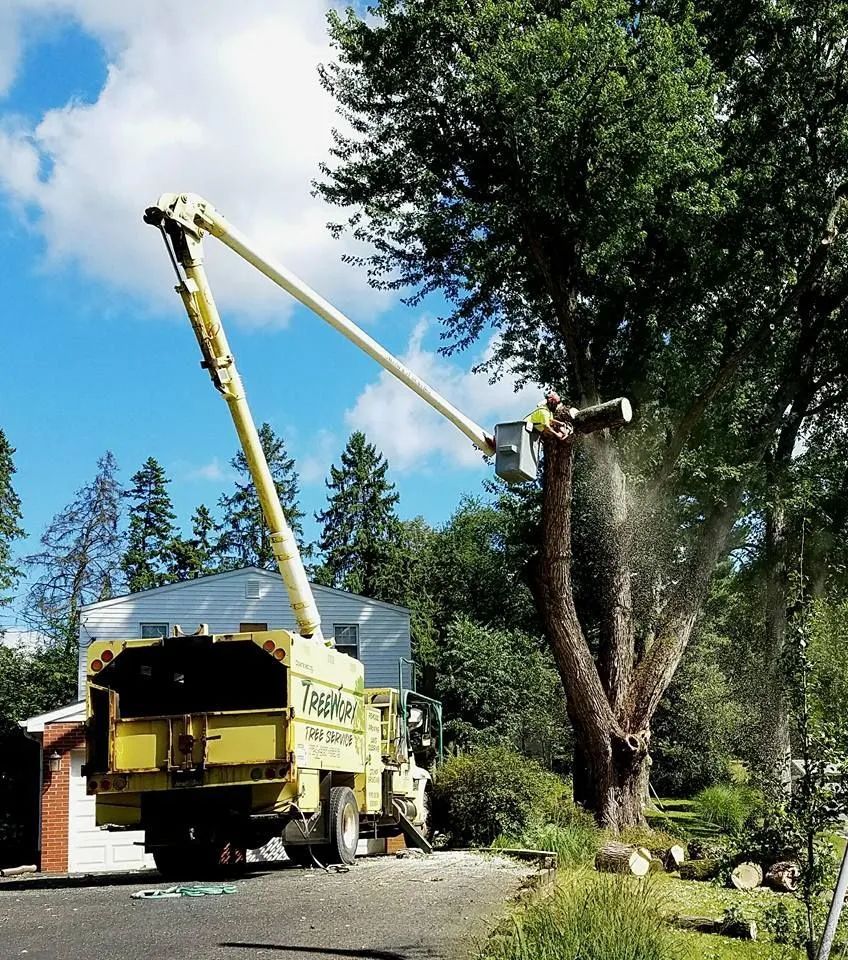
You've got a tree that's too big, too close, or too far gone to bring down with ropes and chainsaws alone. Maybe it's leaning over the garage. Maybe half of it died last summer and the other half is still holding on. Either way, someone's mentioned a crane, and you're wondering what that actually looks like in your backyard.
Quick Answer: Crane-assisted removal uses a mobile crane to lift and lower heavy tree sections in a controlled path, instead of letting a climber cut and drop pieces to the ground. A rigging line and the crane's hook take the full weight of each cut, so the crew can pull whole sections — trunk, limbs, and all — straight up and swing them clear of the house, the fence, or whatever's underneath before setting them down. It's the go-to method when a tree sits too close to a structure, has too much decay to climb safely, or is simply too large for ground-based rigging to control.
Why a Crane Instead of a Climber
Most tree removals don't need a crane. A climber goes up, ties in, and works the tree down piece by piece using rope rigging to control where each cut lands. That works fine on a healthy tree with clear ground space around it.
Problems start when the tree itself becomes the risk. A trunk with heavy internal rot might not hold a climber's weight at all. A silver maple leaning hard toward a roofline gives you almost no margin for error if a rigged piece swings the wrong way. And a tree wedged between a house, a shed, and a power line leaves no safe drop zone no matter how good the rigging plan is. In every one of these cases, keeping people off the tree and letting a crane carry the load changes the entire risk picture.
Sectional removal with a crane also solves a problem ground crews run into constantly: weight. A single oak section three feet across and eight feet long can weigh well over a ton. Rope rigging can lower pieces that size, but it takes multiple redirects, bigger gear, and more time — and there's still a swing radius to manage. A crane picks that same piece straight up, controls it completely in the air, and sets it down exactly where the crew wants it. No swing, no bounce, no guessing.
How the Crew Plans the Lift Before Anything Gets Cut
The work that happens before the saw ever touches bark is where most of the safety margin gets built in. An arborist walks the site first, checking the tree's lean, its decay pockets, root plate condition, and how the canopy is loaded. That assessment decides where cuts go and in what order.
Ground conditions get just as much attention as the tree. A crane's outriggers need firm, level footing, and in the Ohio Valley that's not a given — hillside lots, soft spring ground, and buried utility lines all factor into where the crane can actually park. The crew also maps out overhead lines, fences, sheds, and anything within the swing radius, because the crane's boom and load path have to clear all of it with room to spare.
Once the site work is done, the crew builds a lift plan that spells out cutting sequence, rigging points, and the weight of each section before it comes off the tree. Getting that weight estimate right matters — a crane rated for a certain load isn't guessing at capacity, and neither is the arborist calling the cuts. Everyone on the ground needs to know where a section is headed before it moves an inch.
The Actual Lift Sequence
Once the plan is set, the work follows a rhythm. A rigging line gets attached above the cut point, usually run through a block near the top of the standing trunk or straight to the crane's headache ball. The climber or bucket operator makes the cut while the crane holds tension on the line, so the piece never free-falls even for a second.
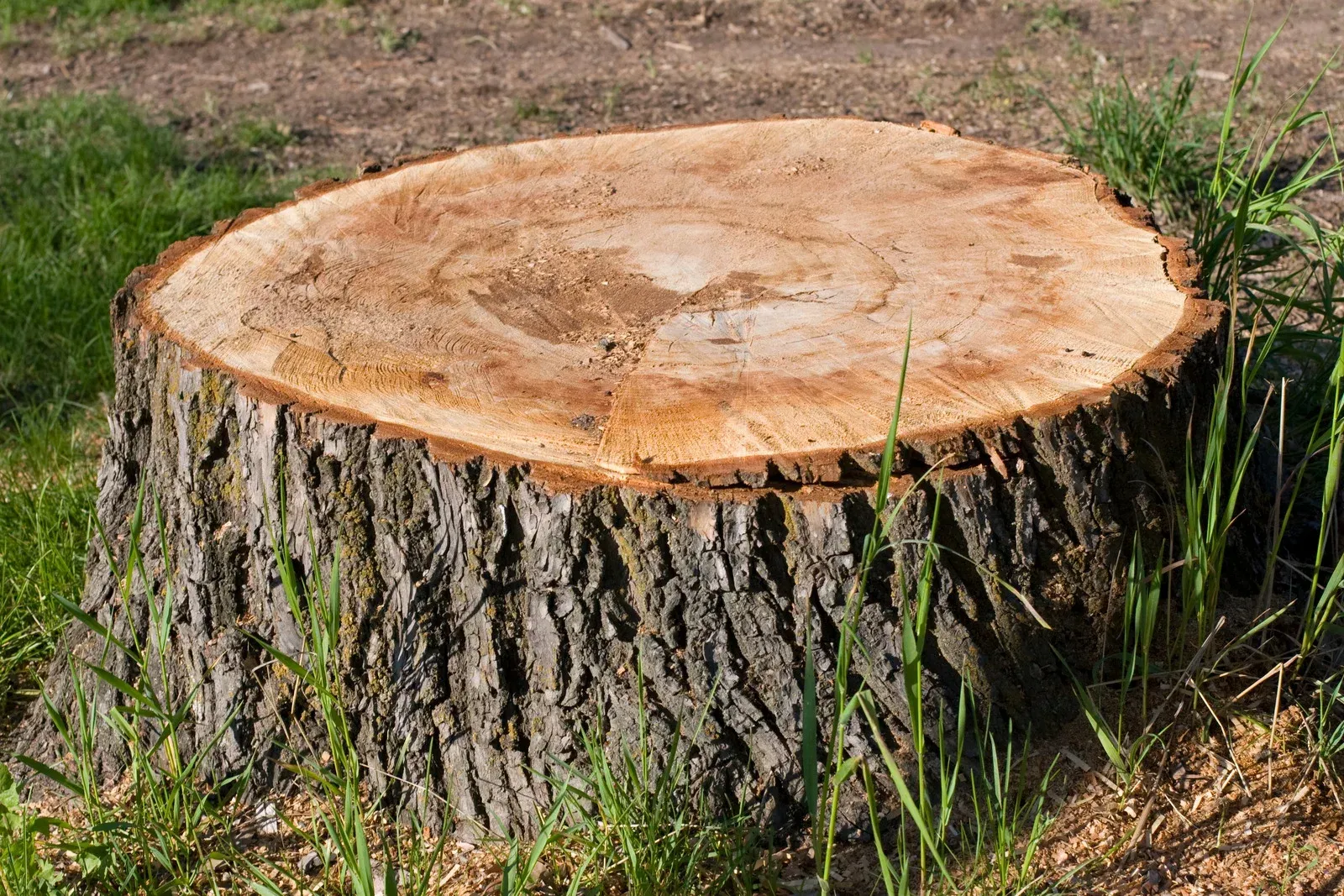
The moment the cut separates, the crane takes full control. The operator lifts the section clear of the remaining tree, swings it over the drop zone, and lowers it onto a pad or directly into a truck for immediate processing. Then the sequence repeats, working down the trunk in sections until only a stump remains.
A ground crew works the whole time this is happening — cutting the section free of rigging once it lands, running the chainsaws, and feeding the chipper. Everybody has a job, everybody stays clear of the load path, and nobody moves until the signal person says it's clear. That coordination is really what separates a smooth crane job from a slow, tense one.
Roles on a Crane Removal Crew
A crane removal isn't a one- or two-person job. There's an arborist directing the cuts, a certified crane operator running the machine, a signal person relaying hand or radio signals between the two, and ground crew handling debris and rigging. Some jobs also need a climber or bucket operator positioned in the canopy to make cuts the crane can't reach on its own.
Every one of those roles depends on clear communication. If the signal person and the operator aren't reading each other correctly, a load can swing further than expected or stop short of its target. That's why crews train together and use the same signals every time, rather than improvising on site.
Every crew has that one job where the ground was softer than it looked or a limb hung up mid-swing, and the whole thing came down to whether the signal person and operator were actually in sync. That's not a knock on the equipment. It's just what happens when heavy machinery meets a living, unpredictable material like wood.
Protecting the Ground Below
One of the biggest reasons homeowners ask for a crane isn't safety at all — it's what happens to everything underneath the tree. Dropping large sections, even with rope rigging, tears up turf, cracks pavers, and puts real stress on anything nearby: a deck, a fence line, a flower bed that took years to establish.
Lifting sections vertically instead of swinging them down to the ground changes that math completely. A crane can pick a piece straight up off the stump, carry it over a driveway or a low fence, and set it in an open yard or directly on a waiting truck. Nothing drags across the lawn. Nothing gets dropped onto a garden bed. For properties with tight side yards, in-ground pools, or septic fields where heavy equipment can't safely drive, that clean lift path is often the only way to get a large tree down without leaving a mess behind.
TIP: If your tree sits near an underground septic field, a paver patio, or newly poured concrete, mention it before the crew shows up. Crane placement and outrigger footing can often be adjusted to avoid ground pressure on sensitive spots, but only if the crew knows about them ahead of time.
Ohio Valley Conditions That Change the Plan
Terrain around Darlington, Beaver County, and the Youngstown area isn't flat, and that shapes every crane job differently than it would on level ground. A crane set up on a hillside lot needs cribbing and leveling that a flat suburban yard never requires, and the reach calculations change depending on whether the crane is picking uphill or downhill from the tree.
Winter adds another layer. Ice-loaded limbs are heavier than they look, brittle at the point of failure, and prone to snapping without warning during the cut. A crane crew working after an ice storm has to account for standing trees that already have hidden stress fractures from the weight they carried overnight. Species matters too — oak and maple hold weight differently than a storm-snapped ash, and a crew that's worked this region for years reads those differences fast.
Access is its own headache in older neighborhoods. Narrow streets, mature trees lining both sides, and utility poles set close to the curb can all limit where a crane can even park before the job starts. Sometimes the whole lift plan bends around finding one spot on the property where the crane can set up and still reach the tree.
When a Crane Isn't the Right Call
Not every big tree needs a crane, and a crew that reaches for one on every job is either overcharging or overcomplicating a straightforward removal. If there's open ground around the tree, no structures in the drop zone, and the wood is sound enough to climb safely, traditional rigging usually gets the job done faster and with less setup.
Cranes earn their keep on the jobs where the alternative simply doesn't work: trees too decayed to climb, spaces too tight for a safe drop zone, or removals where the margin for error next to a house or power line is basically zero. The decision comes down to a real site assessment, not a default answer.
WARNING: Never attempt to rig or drop large sections of a hazardous or leaning tree yourself, even with rented equipment. A trunk under compression or a rotted root plate can shift or fail with almost no warning, and standard homeowner equipment isn't built to control the loads a crane job is designed for. Hazardous trees near structures or power lines call for a professional site assessment before any cutting starts.
Frequently Asked Questions
Does crane removal take longer than a standard tree removal?
Not usually. The planning phase runs a little longer because of the lift plan and site setup, but the actual removal often finishes faster than rope rigging would on a comparable tree. Fewer redirects and no manual lowering add up.
Can a crane remove a tree without touching the lawn?
In most cases, yes. Outriggers need stable footing, but the crew can often position the crane on a driveway, street, or reinforced pad and lift sections completely clear of the lawn, garden beds, and softer ground.
What if the tree is leaning toward the house?
That's actually one of the clearest cases for a crane. Lifting the leaning section away from the structure, rather than trying to control its fall with rope alone, removes most of the risk to the roofline and siding.
Do all tree companies offer crane-assisted removal?
No. It requires a certified crane operator, specialized rigging gear, and a crew trained to work together on lift plans. Not every tree service carries that equipment or experience in-house.
Knowing When the Crane Earns Its Place on Site
Crane-assisted removal comes down to control. Every part of the process, from the first site walk to the last section lifting off the stump, exists to keep weight moving along a path someone chose deliberately rather than a path gravity picked for them. That control is what protects the roofline, the septic field, the fence line, and the crew working below. The machine gets the attention on the day, but the planning behind it does most of the real work.
Whether a crane belongs on your property depends on the tree, the ground under it, and what sits within the drop zone. A sound trunk with open space around it rarely needs one. A hollow trunk leaning hard over a garage almost always does. TreeWorx Tree Service
works throughout Darlington, PA, drawing on 200
years of combined crew experience in reading those differences, and that judgment gets made on site, standing under the canopy, well before a saw ever runs.